Simpson, Emma. Clara and the Birds. Varennes, QC: Milky Way Picture Books, 2024.
Where do you feel you belong? Where are you happy? In this gentle picture book, a little girl enjoys watching birds but finds people more difficult. Other children describe her as shy, but she feels lonely. Until one day when she rescues a small bird in the forest and life changes. Clara might still be shy sometimes, but she can also be brave enough to make friends. A quietly sweet story to share with kids five to eight years old.
Month: February 2026
The Eclipse of 1919
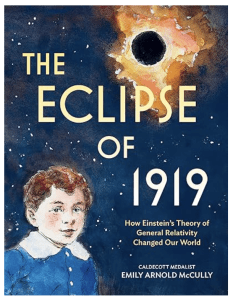
McCully Emily Arnold. The Eclipse of 1919: How Einstein’s Theory of General Relativity Changed Our World.New York: Christy Ottaviano Books, Little, Brown Books for Young Readers, 2025.
What is a theory? Is it an idea or an opinion or a guess? Not for scientists. For scientists, a theory is an explanation of the natural world that is based on repeated, carefully-conducted observations and experiments. An explanation that builds on scientific laws and provable facts.
Albert Einstein, born in Germany in 1879, was not an outstanding student at school. But he was outstanding at thinking about mysterious things. Like what would happen if he travelled faster than the speed of light? Even once he’d graduated from college – fourth in his class of five students – he kept thinking about that question. He had an idea that energy, mass, motion and time were all related. But how could he find evidence for his idea? How could he conduct an experiment that could be repeated over and over again? Why, an eclipse of the sun!
This brilliant picture book by Emily Arnold McCully tells the story of how Einstein came up with the theory of general relativity and how he tested his theory with the help of astronomers and scientists in England. A prologue and an author’s note provide more information. Wonderful pen and ink and watercolour illustrations greatly enhance this biography for readers eight to thirteen years old. Happily recommended for anyone wanting to understand more about the natural world.
Students conducting research projects: note how the author provides a lengthy list of sources at the end. Always properly list where you found your information! Art students: notice how the layout on each double-page spread shows emotion and creates movement.
More books about Albert Einstein
How Democracies Die
Levitsky, Steven and Daniel Ziblatt. How Democracies Die. New York: Crown, 2018.
What are four signs of authoritarian behaviour? The first chapter of this 231-page book by two Harvard professors of government provides an answer. Lack of commitment to democratic processes. Rejection of legitimate political opponents. Acceptance and encouragement of violence. Willingness to limit the rights of opponents. The authors then go on to provide a more detailed explanation of these traits and how they have been demonstrated in American history. While the book in its entirety is only suitable for adults and students of American history, the basic outline is a useful starting point for any class studying forms of government and can be applied to both real-life and fictional situations. Highly recommended.Â
The Wildcat Behind Glass
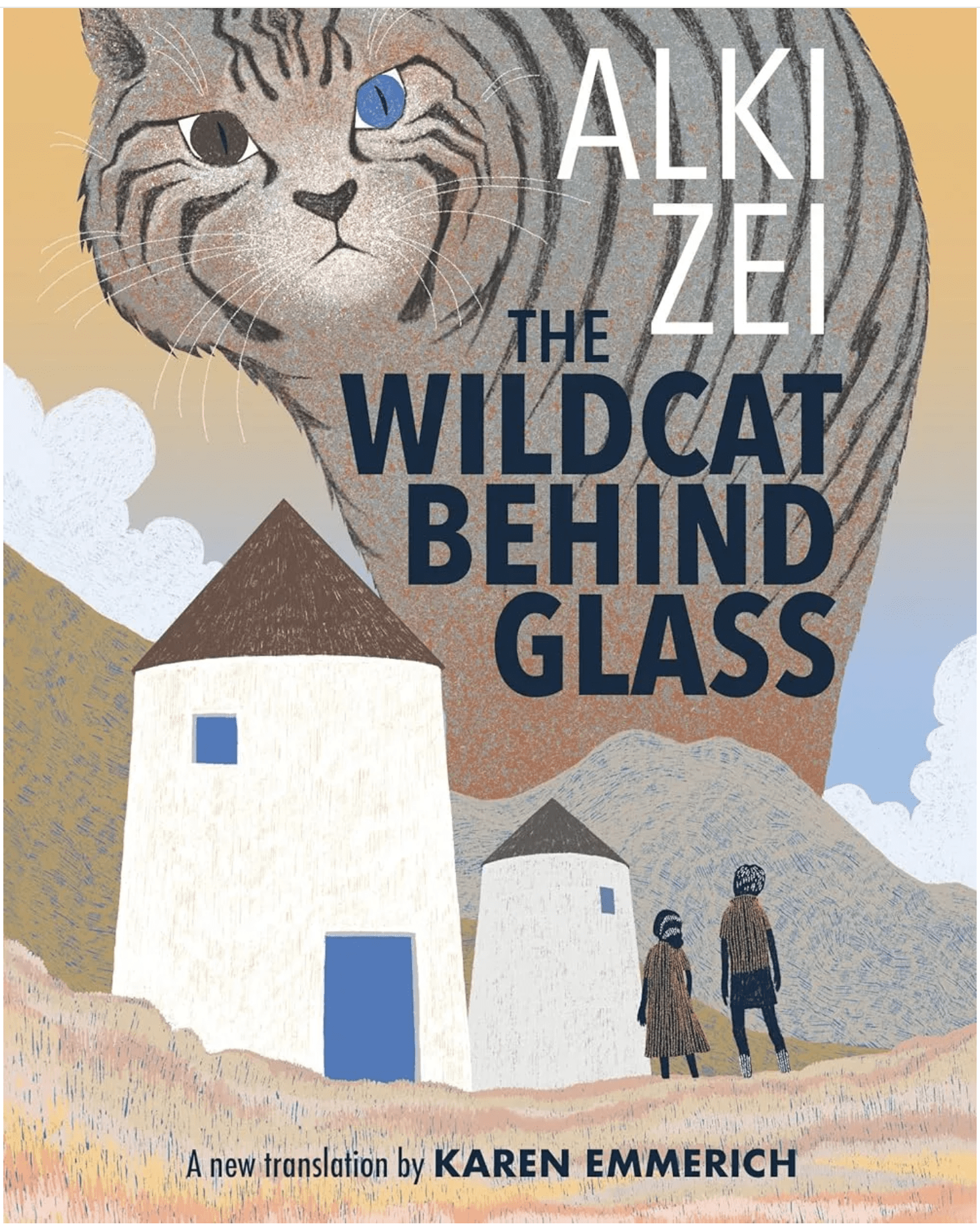
Zei, Alki. The Wildcat Behind Glass. New York: Restless Books, 2024.
How does a democracy disappear? How does a dictatorship take over? This story set on a small Greek island in the summer of 1936, shows fascism quietly but steadily gaining power and dividing a family, putting lives in peril. Written from the point of view of a young girl and inspired by the author’s childhood, the 223-page novel – translated into English – is highly recommended for readers 10 years old and up.Â
More novels about dictatorships
Listen to the translator read an excerpt from The Wildcat Behind Glass
Following the above link implies acceptance of all associated responsibility.